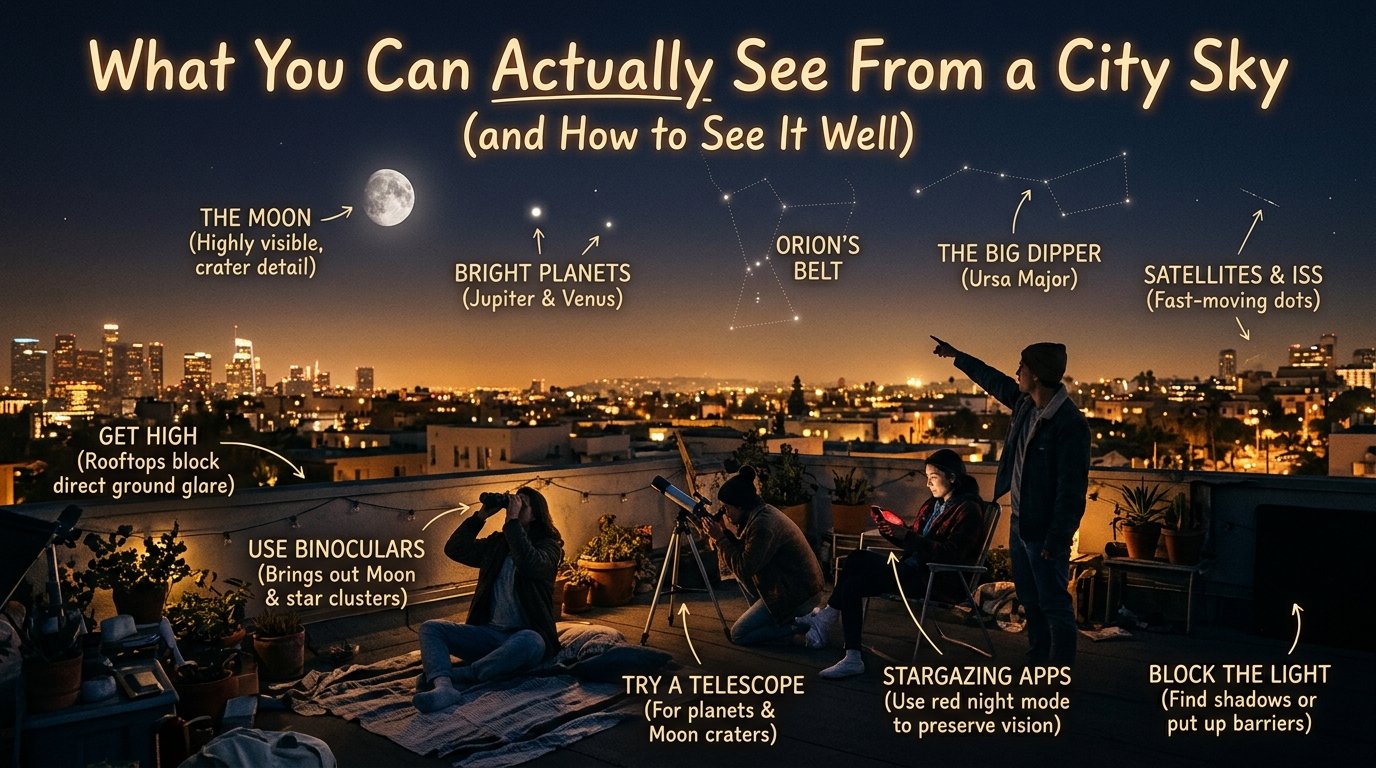
The first time I stood on a rooftop in London on a clear night and looked up, I felt slightly cheated. The sky wasn’t black. It was a warm, murky orange, and where I expected a river of stars I found maybe a dozen pinpricks.
That was years ago, and the answer I eventually found surprised me: city skies hide a lot, but they still contain plenty worth seeing. You just need to stop mourning the stars you cannot see and start hunting the ones you can.
The Honest Truth About City Skies
Light pollution washes out faint objects, that is undeniable. From central London or Manchester, the faintest stars you can pick out are often four or five magnitudes brighter than what a rural observer can see, which means the Milky Way is gone, most galaxies are gone, and the glittering carpet of the winter sky is replaced by a sparse scattering of bright points.
But here is the thing: the brightest objects in the night sky punch through skyglow far better than you might think. The Moon looks just as spectacular from a tower block as from a mountain top. The planets blaze through the haze. The twenty or thirty brightest stars show up easily. And the International Space Station, gliding overhead like a steady, silent star, is easy to catch when the sky is reduced to its main characters. You are not getting the full performance, but you are getting the greatest hits, and the greatest hits are genuinely thrilling.
What You Can Still See
Start with the Moon, which is arguably the single best urban astronomy target. A cheap pair of binoculars turns it into a world of craters, mountain ranges and shadowed plains, and the experience is identical whether you are in Birmingham or in Brecon. Venus glows so fiercely it can cast a shadow under good conditions, while Jupiter’s four largest moons line up beside it in even modest optics.
Then come the bright stars and asterisms. The Summer Triangle, made of Vega, Deneb and Altair, is visible through heavy light pollution. Orion’s belt and sword cut through winter haze. Sirius, the brightest star in the sky, is unmissable even from the most floodlit street. And the Pleiades cluster resolves into its sparkly handful of members. These are not consolation prizes. Seeing the Galilean moons from a city balcony is a genuine astronomical observation, and it counts.
Tactics: Timing, Shielding, and Darker Corners
The good news is that city skies respond to strategy. First, timing matters more than geography. The hour or two after sunset and before sunrise are less polluted than the small hours are not, but moonless nights are gold. Fewer streetlights compete with a sky that has no Moon in it, so it pays to plan around the new moon and make those dark windows your prime observing nights.
Second, shield yourself. A nearby security light can ruin your night vision, but a bit of improvisation fixes it: stand in the shadow of a building, drape a dark towel over your head and the eyepiece, or simply cup your hands around your eyes for a minute.
Third, hunt for darker corners within the city itself. Parks are better than streets. Rooftops above the worst of the ground glare help. Even moving ten minutes toward the outskirts, away from a shopping district or a stadium, can make a measurable difference. For a full list of techniques and what to look for each season, the city stargazing tips collection is a practical starting point written for exactly this situation.
Understanding Magnitude When the Sky Glows
Light pollution makes a mess of casual expectations, so it helps to understand the scale astronomers use. Brightness in the sky is measured in magnitudes, a strange system where lower numbers mean brighter objects, and each step of one magnitude is about 2.5 times brighter than the next. Sirius is magnitude minus 1.5. Polaris is about 2. A faint star at the limit of dark-sky naked-eye vision is magnitude 6.5.
Your local light pollution simply chops the top off that scale. If your sky allows you to see down to magnitude 3.5, you will still see dozens of stars, but nothing fainter. That is why a stellar magnitude explained walkthrough is so useful for urban observers: once you know what the numbers mean, you can read any star chart and instantly judge which targets are realistic from your location.
Making Every Clear Night Count
Here is my honest advice for city stargazers. Keep a small kit ready by the door: binoculars, a warm jacket, and your phone on night mode. When the sky clears, go, even if it is just for fifteen minutes on the balcony. Log what you see: the Moon’s phase, which planets are up, which bright stars you could name. Over a few months, you will build something remarkable, a personal map of your city’s sky, and you will notice the planets moving, the seasons turning the constellations, and the Moon cycling through its phases like clockwork.
And when you finally do escape to properly dark skies, a trip to somewhere like Northumberland or Galloway, the constellations you learned under orange city glow will suddenly gain their fainter companions, and it will feel like meeting old friends who brought the whole family. Everything you learned in the city transfers directly. If you want structured explanations to deepen what you are seeing, the peer-referenced astronomy guides cover the science behind it all, from lunar phases to planetary motion, in language written for beginners.
The city sky is not the whole universe. But it is a doorway, and it is open every clear night.
Leave a Reply