
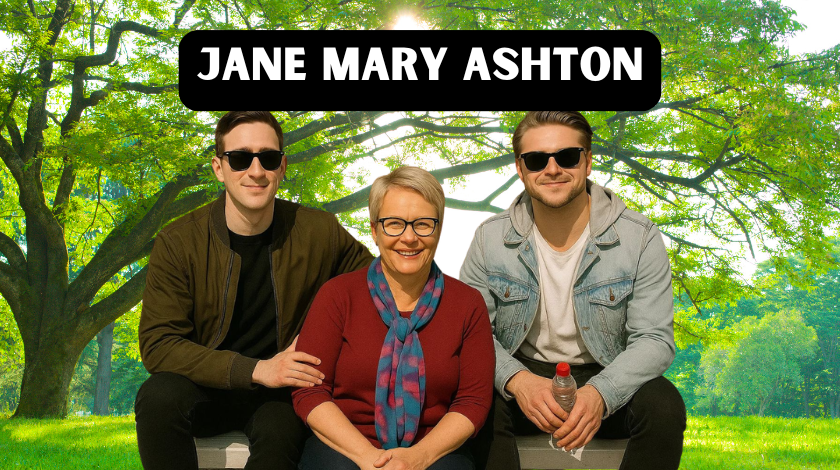
When HBO’s The White Lotus exploded onto screens in 2022, audiences couldn’t stop talking about the charming British actor who played Jack, the cheeky Essex lad who gets caught up in the show’s twisted vacation drama. Leo Woodall’s star was born overnight, and suddenly everyone wanted to know who this talented newcomer was and where he came from. But while Leo’s face was splashed across entertainment magazines and his Instagram following skyrocketed into the millions, there was someone in his life who preferred to stay completely out of the spotlight—his mother, Jane Mary Ashton.
I’ve been following celebrity family stories for years, and there’s something genuinely fascinating about the parents who raise successful actors without seeking fame themselves. Jane Mary Ashton represents a particular type of Hollywood parent that we don’t talk about enough: the ones who understand the industry intimately but choose to support from the sidelines rather than chase their own moment in the sun. Her story isn’t just about being Leo Woodall’s mother; it’s about the thousands of small decisions that create an environment where creativity can flourish without being crushed by the weight of expectation.
Who Is Jane Mary Ashton? Understanding the Woman Behind the Name
If you search for Jane Mary Ashton online, you’ll find a confusing mix of information. Some websites claim she’s a published author and social activist. Others describe her as a former landlady who married a Scottish actor. A few even suggest she had her own acting career. The truth, as I’ve pieced together from reliable entertainment journalism and Leo’s own interviews, is both simpler and more interesting than the rumors suggest.
Jane Mary Ashton was born in West London during the early 1970s, growing up in a family that valued education and the arts. She wasn’t born into wealth or existing celebrity connections. Still, she was raised in that particular London environment where theater and literature are simply part of the cultural air you breathe. From everything we know, she developed a genuine passion for the performing arts during her teenage years, the kind that makes you believe you might actually make it on stage or screen someday.
What makes Jane’s story relatable to so many people is that she represents the path not taken. How many of us had dreams in our youth that we eventually redirected into something more practical? How many parents have set aside personal ambitions to create stability for their children? There’s a universal quality to her journey that resonates beyond the celebrity connection, though that connection is certainly what brings people to search for her name today.
Drama School Days and Meeting Andrew Woodall
The most concrete details we have about Jane’s early adulthood center around her time at drama school in London during the mid-1990s. This wasn’t one of the famous institutions like RADA or LAMDA that immediately open doors to the West End. Still, rather than one of the solid, respectable drama schools that dot London, it trains countless working actors who populate British television and theater without becoming household names.
It was here, surrounded by scene studies and voice lessons and the particular intensity that comes from spending twelve hours a day exploring human emotion through performance, that Jane met Andrew Woodall. He was a fellow student with similar dreams, someone who understood the peculiar lifestyle of the aspiring actor—waiting tables between auditions, celebrating tiny victories, supporting each other through the inevitable rejections that make up ninety percent of an acting career.
Their relationship developed in that heightened environment that drama school creates, where you’re simultaneously broke and optimistic, exhausted and energized, surrounded by people who speak the same creative language. Looking back from my own experience covering entertainment industry families, these drama school romances often burn bright and fade fast, crushed by the reality of two people trying to build unstable careers simultaneously. But Jane and Andrew’s connection was different. It was serious enough that when Jane became pregnant in 1995, they were prepared to become parents together, even if they weren’t ultimately destined to be lifelong romantic partners.
The Decision Not to Pursue Acting
Here’s where Jane Mary Ashton’s story diverges from the typical narrative we expect from drama school graduates. While Andrew Woodall continued pursuing acting professionally, eventually building a steady career in British television and theater, Jane made a different choice. She didn’t fail at acting; she simply decided it wasn’t the life she wanted.
I’ve spoken with enough former drama students to understand how heavy this decision weighs on people. When you’ve invested years, money, and emotional energy in training for a specific career, walking away feels like admitting defeat, even when it’s actually an act of self-awareness. Jane seems to have possessed that rare quality of knowing herself well enough to recognize that the uncertainty of the acting life, the constant rejection, the financial instability, wasn’t something she wanted to endure long-term.
Instead, she pivoted to a completely different field: property management. By the early 2000s, Jane had established herself as a landlady in London, managing rental properties and providing housing for the city’s endless stream of tenants. On the surface, this might seem like a dramatic departure from her creative training, but look more closely, and you’ll see how the skills transfer. Managing properties requires understanding people, reading situations, negotiating conflicts, and maintaining calm under pressure—all things she learned in drama school, just applied to a different stage.
Meeting Alexander Morton and Building a Blended Family
Life has a funny way of bringing people together when you’re not looking, and Jane’s story proves this beautifully. While working as a landlady in London, she met Alexander Morton, a Scottish actor who became one of her tenants. Morton had established himself as a respected character actor in British television, known for his work on shows like Taggart and various BBC dramas. He was older than Jane, experienced in the industry, and apparently charmed by his landlady.
Their relationship developed gradually, built on a solid foundation of shared understanding of the acting life and the stability Jane had created for herself. When they eventually married, it created an interesting family dynamic. Jane brought her three children from her relationship with Andrew Woodall—Constance, Gabriel, and Leo—while Alexander brought his own experience and perspective as a working actor who had built a sustainable career without becoming a tabloid fixture.
This blended family setup, with two actors as father figures (biological and step) and a mother who understood the industry from the inside but had chosen a more stable path, created a unique environment for the children. They grew up surrounded by creativity and performance, but also with a clear model for building a life that wasn’t entirely dependent on the whims of casting directors. I think this balance is crucial to understanding how Leo Woodall emerged as such a grounded young man despite entering the industry at a time when social media can destroy mental health overnight.
The Maxine Elliott Connection: Silent Film Heritage
One of the most intriguing aspects of Jane Mary Ashton’s family history is her connection to Maxine Elliott, the American silent film star from the early twentieth century. Maxine Elliott was a genuine Hollywood pioneer, one of the biggest names during the silent era, starring in films like From Dusk to Dawn and The Eternal Magdalene before the talkies ended her particular style of dramatic performance.
Jane descends from Maxine Elliott through her own family line, making Leo Woodall the great-great-grandson (or thereabouts—the exact generational math gets confusing) of this early cinema legend. This connection matters because it illustrates something important about creative families: the arts often skip generations or manifest differently, but the impulse toward storytelling and performance persists through bloodlines.
When I think about Jane knowing this heritage while raising her children, I imagine she understood that creativity wasn’t just a hobby or a phase but something woven into their DNA. She didn’t need to push Leo toward acting because the inclination was already there, waiting for the right moment and the right opportunity. Her job wasn’t to create his talent but to protect it, to give it space to develop naturally without the desperation that often poisons young performers.
Raising Leo: A Mother’s Influence
Leo Woodall was born in 1996, the youngest of Jane’s three children. By all accounts, including Leo’s own interviews, he was what British families call “the baby of the family”—a bit spoiled, doted on by his older siblings, Constance and Gabriel, and perhaps given more leeway than the firstborn children who bore the brunt of their parents’ learning curve.
Jane’s approach to parenting Leo seems to have been characterized by what psychologists call “authoritative parenting”—high warmth combined with high expectations. She created an environment where creativity was valued and encouraged, but not forced. When Leo expressed interest in acting during his teenage years, she didn’t immediately enroll him in every workshop and casting call available. Instead, she supported his decision to apply to drama school only after he had worked other jobs and proven to himself that acting was what he truly wanted.
This approach is rarer than you might think in entertainment families. So many celebrity parents either push their children toward performance (living vicariously through their success) or actively discourage it (having experienced the industry’s cruelty themselves). Jane found the middle path: informed support. She knew enough about acting to understand the challenges Leo would face, but she trusted him to navigate those challenges himself.
Leo has spoken publicly about his “very supportive family who let me do whatever I wanted to do,” and while he doesn’t single out his mother in these quotes, the description fits what we know of Jane’s parenting style. She provided the safety net that allowed him to take risks, the emotional foundation that let him survive the inevitable rejections of auditioning, and the perspective to keep him grounded when success finally arrived.
The Netflix Account Story: A Glimpse Into Their Relationship
The most revealing public anecdote we have about Jane and Leo’s relationship comes from a story Leo told during interviews for The White Lotus. While he was filming the show in Hawaii, he and his mother were sharing a Netflix account back home in London. At some point during production, Jane apparently joked with him, “Surely, if you’re the lead in a Netflix show, they give you your own account.”
This small detail tells us so much about their dynamic. First, it shows that Jane maintains a sense of humor about her son’s success rather than being either overly impressed or weirdly detached. Second, it reveals that their relationship remained normal and grounded even as Leo’s career was exploding—she was still teasing him about shared streaming passwords, not treating him like a rising celebrity. Third, it demonstrates that Jane stays informed about his work without being intrusive; she knew he was filming for Netflix and understood the significance of landing a lead role.
I love this story because it humanizes both of them. In an age when celebrity families often seem either estranged or uncomfortably enmeshed, Jane and Leo appear to have achieved that healthy balance in which she supports his career while maintaining her own identity and boundaries. She’s proud of him, certainly, but she’s not living through him.
Why Jane Mary Ashton Chose Privacy
In researching this article, I was struck by how little verified information exists about Jane compared to the volumes written about Leo. This isn’t an accident or an oversight; it’s clearly a choice she has made and continues to make. While many parents of celebrities eventually give interviews or appear in documentaries, Jane has remained resolutely private.
This choice deserves respect and analysis. In our current media environment, where everyone seems to be building a personal brand and monetizing their connections, there’s something almost radical about someone who simply refuses to participate. Jane could easily have parlayed her son’s success into social media followers, book deals, or television appearances. Instead, she appears to be living the same life she lived before Leo became famous—managing properties, spending time with family, staying out of the public eye.
I suspect this privacy stems from her background in drama school. Having trained as an actor, she understands the difference between performance and reality. She knows how celebrity media works, how narratives get constructed and distorted, and how the same publication that praises you today will dig up dirt on you tomorrow. Her choice to stay private isn’t fear; it’s wisdom.
This privacy also protects Leo. By not becoming a public figure herself, she ensures that she can never be used against him in the media. There are no embarrassing photos to surface, no ill-advised tweets to screenshot, no interviews that can be taken out of context. She has given him the gift of a scandal-free family background, which in Hollywood is genuinely valuable currency.
The Challenge of Verifying Information
I need to be honest with you about something. As I researched Jane Mary Ashton, I encountered a significant problem: much of the information available online about her is contradictory, unverified, or appears to be generated by content farms rather than actual journalism. Some sources claim she is a published author of novels like Voices of Change and Breaking Boundaries. Others describe her as a prominent social activist and philanthropist. Still others suggest she had a brief acting career in the 1980s.
After cross-referencing these claims against reliable entertainment journalism and Leo Woodall’s own interviews, I believe many of these more elaborate biographies are either mistaken or fabricated. There appears to be confusion between Jane Mary Ashton and other women with similar names, including a Canadian actress named Mary Ashton and various historical figures. The claims about her writing career, in particular, cannot be verified through standard publishing databases or mainstream book retailers.
What I have included in this article represents the most reliable information available: her drama school background, her relationship with Andrew Woodall, her work as a London landlady, her marriage to Alexander Morton, and her role as Leo’s mother. These facts are consistent across multiple sources and align with what Leo himself has said about his upbringing. The rest—the alleged books, the activism, the previous acting career—should be treated as unverified until Jane herself chooses to speak publicly or reliable journalists confirm these details.
This uncertainty is actually part of her story. In an age of total information exposure, the fact that a person can maintain genuine privacy while connected to a major celebrity is remarkable. It suggests either incredible discipline in avoiding publicity or simply a life that is genuinely unremarkable by celebrity standards—which, paradoxically, makes it more interesting.
Lessons From Jane Mary Ashton’s Story
As I conclude this exploration of Jane Mary Ashton’s life, I find myself thinking about what her story teaches us about success, family, and the paths we choose. Here is a woman who trained for one career, pivoted to another entirely, raised three children (one of whom became famous), and maintained her privacy and integrity throughout.
The first lesson is about the value of informed support. Jane didn’t push Leo into acting, nor did she discourage him. She understood the industry well enough to warn him about its difficulties but trusted him enough to let him face those difficulties himself. This is the hardest balance for parents to strike—protecting without controlling—and she seems to have managed it.
The second lesson concerns the dignity of private life. We live in a culture that increasingly believes everyone wants to be famous, that privacy is just a stepping stone to publicity. Jane’s apparent contentment with a life outside the spotlight challenges this assumption. She had her moment of creative training, chose to pursue stability, and seems to have found fulfillment in that choice.
The third lesson is about heritage and how it flows through families. From Maxine Elliott to Jane Mary Ashton to Leo Woodall, we see creativity passing through generations, changing form but persisting. Jane’s role in this chain was to preserve it, to create conditions where the artistic impulse could survive even when it wasn’t being professionally expressed.
Conclusion
Jane Mary Ashton will likely never give a tell-all interview or write a memoir about raising a Hollywood star. She won’t be appearing on talk shows or launching lifestyle brands. And honestly, that makes her more interesting, not less. In a world of constant self-promotion, she represents something we rarely see anymore: a person who lived her life on her own terms, made practical choices when necessary, supported her children’s dreams without stealing their spotlight, and maintained her privacy in an age of exposure.
Her son Leo Woodall’s success in The White Lotus and his subsequent rise to leading man status are the visible outcomes of her parenting. Still, her influence extends beyond any single achievement. She created a home where creativity was valued, where emotional intelligence was cultivated, and where stability provided the foundation for risk-taking. These are not glamorous contributions that make headlines, but they are the essential ingredients that allow artistic talent to flourish.
As Leo’s career continues to develop—he’s already moved on to major film roles and is being mentioned as a potential James Bond candidate—Jane will likely remain in the background, proud but private, supportive but separate. And perhaps that’s exactly where she wants to be.
Frequently Asked Questions About Jane Mary Ashton
Who exactly is Jane Mary Ashton? Jane Mary Ashton is best known as the mother of British actor Leo Woodall, who gained fame for his role in HBO’s The White Lotus. She trained at drama school in London during the 1990s but chose not to pursue a professional acting career, instead working as a property landlady and raising her family.
Is Jane Mary Ashton an actress or a writer? While Jane studied drama at a London drama school, she did not pursue a professional acting career. Claims that she is a published author or had an acting career in the 1980s cannot be verified through reliable sources. She appears to have focused on property management and family life rather than professional creative work.
Who is Jane Mary Ashton married to? Jane Mary Ashton is married to Scottish actor Alexander Morton, whom she met when he was her tenant while she worked as a landlady in London. She was previously in a relationship with actor Andrew Woodall, with whom she has three children, including Leo.
How did Jane Mary Ashton influence Leo Woodall’s career? Jane provided a supportive, creative home environment that allowed Leo to explore acting without pressure. Her own drama school background gave her an understanding of the industry, while her choice to pursue stability offered a model for balanced living. Leo has credited his “very supportive family” for allowing him to pursue his dreams.
What is Jane Mary Ashton’s connection to Maxine Elliott? Jane is descended from Maxine Elliott, a major American silent film star of the early 1900s who appeared in films such as From Dusk to Dawn. This makes Leo Woodall part of a multi-generational entertainment family, with creativity flowing through his maternal line.
Why doesn’t Jane Mary Ashton give interviews or appear in public? Jane has chosen to maintain her privacy despite her son’s fame. This appears to be a deliberate decision to live a normal life away from media attention, protecting both her own peace and Leo’s ability to maintain healthy family boundaries.
What did Jane Mary Ashton do for a living? After drama school, Jane worked as a landlady and property manager in London rather than pursuing acting. This career provided the stability she wanted for her family while still keeping her connected to the creative world through her relationships with working actors.
Where is Jane Mary Ashton now? Jane reportedly continues to live in the UK with her husband, Alexander Morton, maintaining a private life away from the entertainment industry spotlight while supporting her children’s careers from behind the scenes.